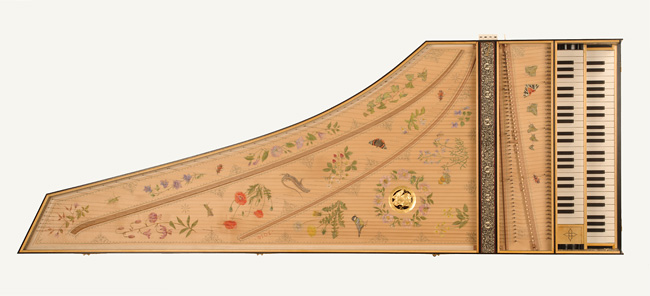
| Virginal (spinet) after Ioannes Ruckers c. 1600 | 8' | C/E-c''' | |
| Virginal (muselar) after Andreas Ruckers 1620 | 8' | C/E-c''' | |
| Virginal (spinet) after Ioannes Ruckers 1629 | 8' | C/E-d''' | |
| Harpsichord after Andreas Ruckers 1637 | 8'4' | C/E-c''' | |
| Harpsichord after Ioannes Ruckers 1638, two-pitch-instrument, double-manual | 8'4'8'4' | C/E-f''' | |
| Harpsichord after Ioannes Ruckers 1624, petit ravalement, double-manual | 8'4'8' | GG,AA-d''' | |
| Harpsichord after Ruckers, grand ravalement, double-manual | 8'4'8' | FF-f''' | |
| Harpsichord after Albert Delin of the mid-18thcentury | 8'8' 8'8' |
C-e''' GG-e''' |
|
| Harpsichord after Johann Daniel Dulcken 1747 | 8'4'8' | FF-f''' | |
| Harpsichord after Johann Daniel Dulcken 1745, double-manual | 8'4'8' | FF-f''' |